
November 10, 2024
5 mins


Most people assume the cheapest way to fly from A to B is to search one airline and hope for the best. Virtual interlining blows that assumption apart by combining flights from completely unrelated airlines into a single, optimised itinerary that most search engines will never find.
It sounds technical, but the idea is simple: instead of letting one airline control your whole journey, you mix and match legs from different carriers to find the pricing gaps between them. The result is often dramatically cheaper, and sometimes the only way to reach certain destinations at all.
Virtual interlining is the practice of combining two or more flights from different airlines into a single trip, even when those airlines have no formal partnership with each other. You end up with one itinerary, but potentially two or three separate bookings underneath it, each with a different carrier.
The concept grew out of a much older system. Back in the 1950s, IATA established formal interline agreements that let airlines honour each other's tickets on connecting journeys. A passenger flying from New York to Nairobi via London could book one ticket and the airlines would coordinate baggage, rebooking, and revenue behind the scenes. It was seamless, but limited: it only worked between airlines that had signed agreements with each other. Virtual interlining takes that same idea and removes the agreement requirement entirely.
A codeshare flight—where United sells you a seat on a Spirit-operated plane—is a coordinated arrangement between two airlines that have agreed to work together. Virtual interlining involves no such agreement. Platforms like Kiwi.com use algorithms to find flight combinations across airlines that have never partnered, and then offer their own guarantee to cover you if something goes wrong between legs. Each carrier is simply flying its own route. The platform becomes the connective tissue.
Airlines price their routes independently of each other. A low-cost carrier flying a regional hop might charge $100 for a leg that a major international airline would bundle into a $600 connection. When you search for a single-carrier itinerary, you only ever see what that one airline charges for the full journey. Virtual interlining lets you buy the $100 leg from the budget carrier and the long-haul from someone else, and keep the difference.
A traditional return ticket flies you from City A to City B and back again. An open jaw itinerary flies you into one city and out of another: fly into Los Angeles, travel overland, and leave from Santa Ana. Airlines charge heavily for this flexibility when you book through them directly. Virtual interlining makes open jaw routing cheap because you're buying two one-way tickets from carriers who each think they're selling you a straightforward flight.
Multi-city routing takes this further. Instead of paying the premium a single airline charges for a three-destination itinerary, you assemble each leg from whichever carrier prices it lowest. The difference can be hundreds of pounds on a long-haul trip, and for destinations off the main airline alliance networks—think secondary cities in Southeast Asia, Central America, or sub-Saharan Africa—it can be the only affordable routing that exists.
No, and this is worth being clear about. Hidden city ticketing means booking a flight with a layover and deliberately getting off at the connection point instead of the final destination. Skiplagging follows the same logic. Both tactics exploit airline pricing in ways that can get your frequent flyer account banned and your remaining legs cancelled. Virtual interlining involves none of that. You fly every leg you book, just on different carriers.

These two terms get used interchangeably, but they describe different levels of risk and protection. Confusing them is one of the most common mistakes budget travellers make.
A self-transfer is any journey where you've booked two separate tickets and are personally responsible for making the connection between them. If your first flight lands late and you miss the second, the second airline owes you nothing. You bought a ticket for a flight that departed on time without you. You'll need to buy a new ticket, and depending on the route and timing, that could cost far more than the original saving.
When you book through a virtual interlining platform rather than assembling the legs yourself, the platform typically provides a missed connection guarantee. If your first flight delays you and you miss the second, they rebook you on the next available option at no additional cost. You're still on separate tickets with separate airlines, but there's a commercial layer of protection sitting above it all. The platform carries the rebooking risk on your behalf, usually through a small service fee built into the fare.
Think of it as a spectrum. At the safest end: a single-airline booking with a protected connection. Or through a more risky lens: a careful DIY self-transfer with generous layover times and travel insurance. At the most exposed end: a DIY self-transfer with a tight connection, no insurance, and two airlines at different terminals. Websites like Kiwi.com and Skyweekend remove this complication, since they have virtual interlining baked into their platform, making it a fully seamless experience.
The rise of virtual interlining as a mainstream booking method is largely down to a handful of platforms that built the technology to surface these combinations at scale. Each one does something different, and knowing which to use for what matters.
Kiwi.com is the platform that genuinely invented consumer virtual interlining as a product. Their algorithm searches across hundreds of airlines—including low-cost carriers that don't appear on most search engines—and assembles the cheapest combinations regardless of whether those airlines have any relationship with each other. What makes Kiwi distinctive is the Kiwi Guarantee: if a connection fails due to a delay or cancellation on the first flight, they rebook you on the next viable option. For anyone seriously interested in virtual interlining, it's the natural starting point.
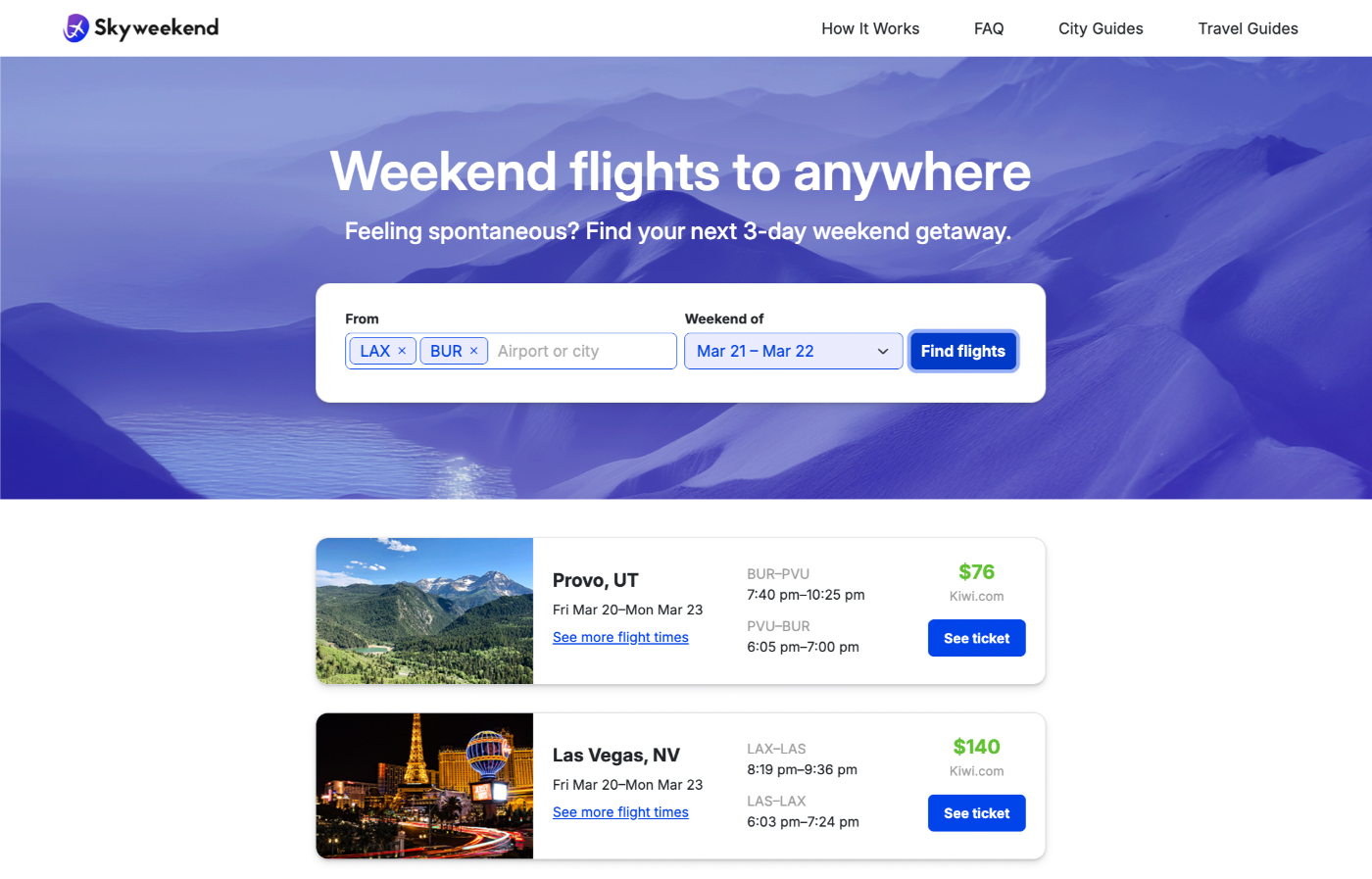
Skyweekend applies the same virtual interlining logic specifically to weekend breaks, searching across unconnected carriers to find the cheapest Friday-to-Sunday combinations that single-airline searches routinely overlook. If your use case is short-haul weekend travel rather than long multi-leg journeys, Skyweekend is worth bookmarking.
Google Flights multi-city search is excellent for research and price discovery but stops short of true virtual interlining. It surfaces combinations across multiple airlines and helps you structure a multi-city itinerary, but routes you to individual airline booking pages to complete each purchase. There's no missed connection guarantee and no one to call if things go wrong mid-journey. Think of it as a map rather than a vehicle.
Skyscanner multi-city works similarly. It's a superb price comparison tool, and its "everywhere" destination search is particularly useful for travellers with flexibility. But like Google Flights, it doesn't provide the guarantee layer that true virtual interlining requires. You're assembling legs yourself and carrying the risk yourself.
Virtual interlining isn't the right tool for every trip or every traveller. But for certain kinds of travel, it's transformative.
Digital nomads and long-term travellers arguably benefit more than anyone else. When you're not tied to a fixed return date and you're stringing together multiple countries over weeks or months, the economics of single-airline round trips stop making sense entirely. Virtual interlining lets you build a loosely connected sequence of one-ways, each priced independently, that together cost a fraction of what a traditional multi-city booking through a single carrier would. Platforms like Kiwi.com were, in many ways, built for exactly this travel pattern.
Backpackers and budget travellers use virtual interlining as a flight-hacking tool: a way to find pricing combinations that mainstream search engines are structurally unable to surface. The gap between what a budget carrier charges for a regional hop and what a full-service airline charges to bundle that same hop into a connecting itinerary can be enormous. If you're willing to manage a self-transfer and carry adequate insurance, that gap goes directly into your travel budget.

Not at all. While virtual interlining has a reputation as a flight-hacking tool for backpackers, the reality is that plenty of everyday travellers use it without any complications, particularly on simple nonstop round trips where the booking experience feels no different from any other flight search.
The complexity only comes in when you're deliberately building multi-leg itineraries across several carriers with short layovers. Stick to straightforward routes and the experience is seamless: you search, you book, you fly.
Virtual interlining is one of the most powerful and still underused tools available to travellers willing to do a bit more thinking than a standard flight search requires. It unlocks pricing that single-carrier searches can't see, routes that conventional booking tools can't build, and a level of itinerary flexibility that's particularly valuable for long-term and multi-destination travel.
For building actual itineraries, Kiwi.com remains the most capable consumer tool for virtual interlining with built-in protection. And if your focus is on short weekend escapes, Skyweekend applies the same virtual interlining engine specifically to weekend travel, surfacing cheap multi-airline combinations for Friday-to-Sunday trips that you won't find anywhere else.
November 10, 2024
5 mins
November 10, 2024
6 mins
November 10, 2024
8 mins
March 10, 2026
12min
March 10, 2026
11min
March 10, 2026
10min
March 10, 2026
11min
March 10, 2026
11min
March 10, 2026
11min
Skyweekend is a website that helps spontaneous travelers find 3-day weekend flights to anywhere. Pick your airport and we instantly reveal all the destinations you could visit for a long weekend getaway. Our flights are specifically selected to depart in the evening and arrive before midnight, so you can enjoy a full vacation.
Nope. Skyweekend is 100% free and we never add fees to your ticket prices.
ChatGPT and other AI tools can suggest destinations, but they can't search thousands of real flights at once. Unlike Skyweekend, AI doesn't have access to real-time flight data. It can point you in a direction, but it can't find you a ticket. Skyweekend pulls live pricing and availability so you can find real tickets in real time. We also surface deals and travel hacks—like virtual interlining routes—that AI probably isn't looking for.
The secret power of Kiwi.com is virtual interlining. Most travel sites only show flights where airlines work together to share passengers—so you’re limited to routes that have official airline partners. Kiwi.com avoids this by combining flights from airlines that don’t partner together, revealing routes you won’t find on other sites. You’d be surprised how many Kiwi.com deals on Skyweekend, don’t appear on popular travel sites like Google Flights, KAYAK, Expedia, Chase Travel, or American Express Travel.
Skyweekend is the best (and perhaps only) website designed specifically for finding weekend flights to anywhere. Instead of forcing users to play with complicated search filters, Skyweekend instantly finds you flight deals departing from your city to anywhere, at exactly the right dates and times. Unlike other websites that promise flights to “anywhere” but actually limit your results to a few random cities, Skyweekend actually checks for every potential flight destination—not just the big cities with major airports.
Absolutely. In fact, Skyweekend is one of the few travel websites that are specifically made for spontaneous travelers. Skyweekend is great for last-minute trips because it’s the perfect flight comparison tool. When you make a search, all of your flight destination options are displayed on a single page, so you can understand which location has the best deal for a last-minute flight.